Unwrap
Tear the outer sachet and remove the folded filter.
 Get a Quote
Instant & Single-Serve Coffee Packaging
A hanging-ear filter and protective outer sachet for fresh pour-over coffee anywhere.
Sizes & capacity: 8 g to 15 g and custom doses
Use case
Drip Coffee Bags coordinate an inner filter, ground-coffee dose, and protective outer sachet for pour-over use. Confirm filter flow, dose, outer barrier, opening direction, and filling route as separate but linked decisions.
Format details
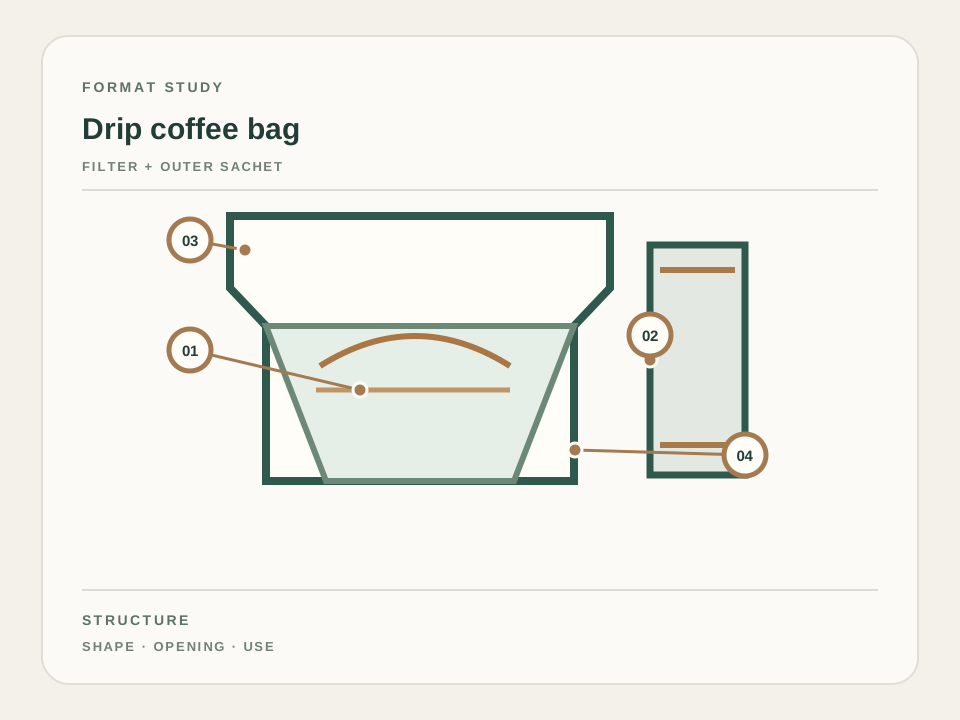
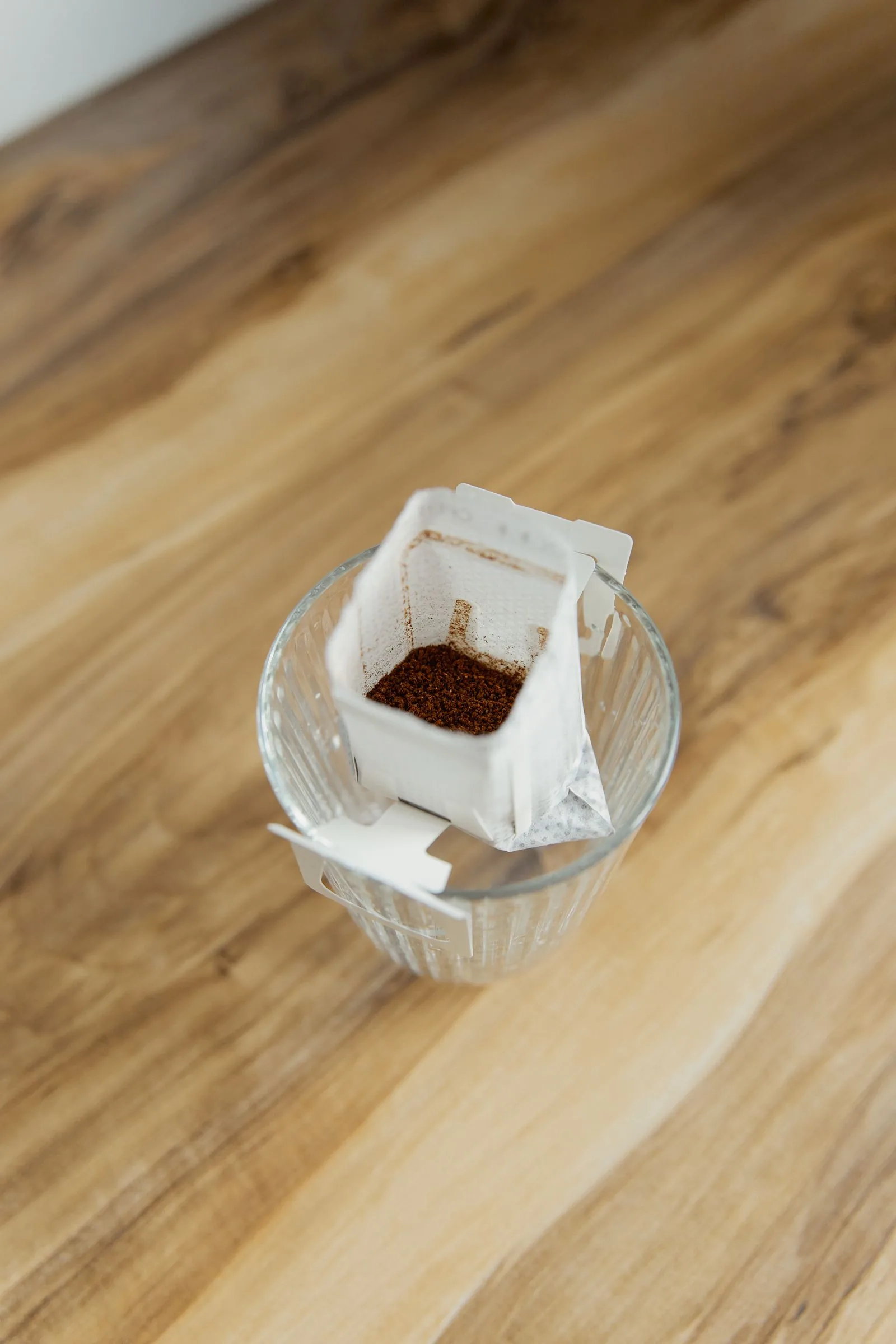
This drip coffee format combines a folded filter containing ground coffee with an outer barrier sachet. The filter is opened above a cup and used to brew; the outer sachet protects the unused filter during storage and travel. These are different parts with different jobs. The filter paper or fabric, dose, fold size, and brewing flow are chosen for the inner portion, while the outer laminate, tear opening, and seal are chosen around the packed filter.
Practical sequence
Tear the outer sachet and remove the folded filter.
Open the filter and position its supports over the cup.
Pour water through the bed and remove the filter after draining.
Choose filter material, dose, fold style, outer sachet laminate, opening notch, print, and unit count.
Brew with the intended grind and cup, then check outer-sachet opening, filter fit, flow, and grounds containment. Keep the outer pack and filter together through handling so the trial reflects the actual packed portion.
A brand is assembling a six-portion drip coffee set. Treat the brew filter, its individual outer sachet, and the retail carton as three related components. Confirm dose and grind in the filter; measure the filled and folded filter before fixing sachet dimensions; then test opening direction and seal clearance. Finally, verify the portion count, carton arrangement, barcode, and any batch code. Ask whether the outer packs are premade or roll-fed. A well-designed carton cannot compensate for a filter that brews poorly or a sachet that is difficult to open. Keep the filter dimensions, outer sachet, and carton revision linked so a change in dose or fold is not carried forward into an untested pack size. Review filter, sachet, and carton together at the final portion count.
Plan around this format
Decide this format in two layers. First test the filter with the intended grind, dose, water recipe, and cup range; then size the outer sachet around the filled and folded filter with enough loading room and clean seal area. Confirm whether the partner uses premade sachets or rollstock, and keep the outer pack’s opening direction separate from the filter’s ear fit.
Check grounds containment, extraction flow, ultrasonic or heat-seal results, lot-code space, and the final retail count. Approve the filter and outer barrier as coordinated but separately documented components.
Buying notes
Open the question that matches your next decision.
The listed size or capacity options are 8 g to 15 g and custom doses. Confirm the project dimension or capacity, product dose where relevant, seal area, and filled or assembled dimensions before approving the artwork.
The inner filter holds the dose and controls brewing; the outer sachet protects it before use. Confirm dose, filter flow, outer barrier, opening direction, and filling route as separate but coordinated parts.
Send the product, target size or dose, current format, artwork status, quantity, destination, and preferred sample or quote route. Start with PET/VMPET/PE; PET/AL/PE; Kraft/PET/PE outer pouch and use the checks below to frame the first discussion.
Choose with confidence
For a drip-coffee project, the brewing filter and its protective outer sachet do different jobs. Confirm both so your customer can open, position and brew the portion as intended.
See how samples are reviewedShare the grind, dose, intended cup range and packing equipment. Check which filter and outer-pack components are included, how they are filled and how the filter sits on the cup before choosing final dimensions.
Use the outer sachet to identify the coffee and explain the opening and brewing steps. Confirm its print area, seal zones and code space separately from the inner filter’s shape and supports.
Try the actual dose, filter opening, cup fit and brewing routine, then review the outer pack’s filling and sealing. Ask for samples that match the question you need to answer; a decorated outer pack alone cannot confirm the brew experience.
In practice
Show customers what to open, where to place it and how to use the portion.
Define whether the enquiry covers a filter, an outer sachet or a packed retail set. The filter supports brewing, while the sealed outer pack protects the portion before use.
A box organizes the servings but does not automatically replace their protective packaging. List the components and quantities separately when comparing quotations so a cheaper offer is not mistaken for the same complete supply scope.
Review the sequence from tearing the outer sachet to removing and opening the filter. Check whether the customer can identify the correct opening without damaging the supports. Keep instructions short enough to read at the actual printed size.
If the artwork uses illustrations, test them with a first-time user and observe the action. Attractive icons alone do not prove that the brewing steps are understood.
Record the coffee dose, grind, cup used and brewing approach during the sample review. If the filter or outer pack changes, that record gives the coffee and packaging teams a common starting point.
Any printed brewing recipe should come from the brand’s own confirmed preparation method. Packaging samples help assess fit and handling; they are not a substitute for a coffee-quality or storage study.
Product enquiry
Share your coffee, fill weight, planned quantity and destination. Ask about fit, samples or pricing; we will review the details needed for a useful quotation.
Custom production usually starts from 10,000 pieces. Available standard samples are free; shipping is confirmed separately.