Whole bean and ground coffee should not be placed into the same packaging specification by changing only the product name. Grinding changes the exposed surface area, gas-release behavior, aroma-loss route, bulk density and filling behavior. The package therefore needs to be reviewed as part of the full coffee and packing process.
The main specification differences
| Input | Whole bean coffee | Ground coffee |
|---|---|---|
| Product state | Porous roasted beans continue to release gas after roasting | Greater exposed surface area changes gas and aroma behavior |
| Fill test | Bean size, origin, roast and density affect occupied volume | Grind range, settling and filling method affect occupied volume |
| Valve decision | Often reviewed when coffee is packed soon after roasting | Depends on packing timing, process, residual oxygen and format |
| Barrier review | Match freshness target and route to the complete laminate | Give extra attention to oxygen exposure, process and seal integrity |
| Verification | Filled stance, valve, zipper, seal and distribution trial | Filling dust, seal contamination, residual oxygen and pack trial |
Whole bean projects begin with roast and packing time
Record the roast direction and the normal interval between roasting and sealing. Coffee packed while it is still releasing substantial carbon dioxide may require a one-way degassing valve, adequate headspace and seals that remain controlled during the expected pressure cycle.
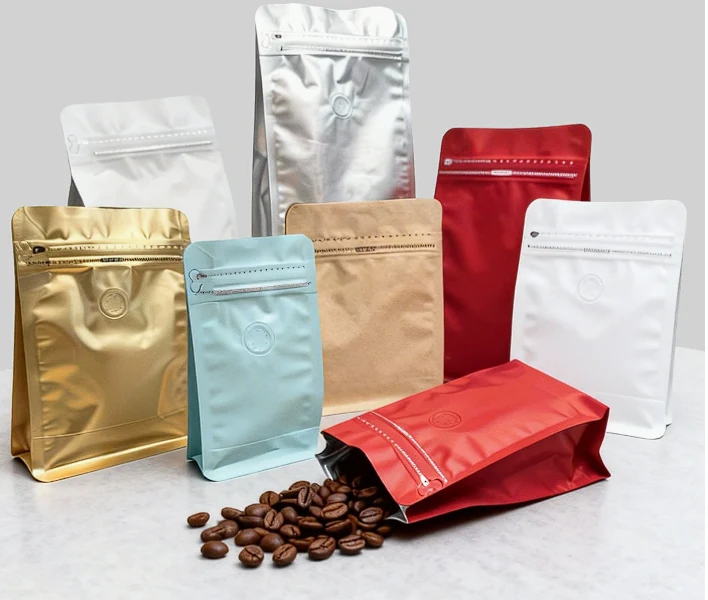
The valve is not a generic freshness button. Its model, position and installation must match the laminate, zipper, net weight and filled geometry. See the coffee bean packaging range for formats designed around these decisions.
Ground coffee projects begin with grind and filling process
For ground coffee, record fine, medium or coarse direction, whether several grinds share the package, and how the product is dosed. Fine particles near the top-seal area can interfere with sealing if the filling and cleaning process is not controlled.
The team should also record whether the line uses vacuum, gas flushing or another oxygen-management route. The package recommendation must match the actual process rather than assuming that a valve used for whole beans should automatically be repeated. Browse ground coffee packaging formats for the relevant starting points.
Barrier values need a defined target
OTR and WVTR reports describe the tested material under stated conditions. They do not by themselves establish shelf life for every coffee. The project should connect the target freshness window, distribution time, temperature, humidity, residual oxygen, valve and seal performance to the exact approved construction.
Run production-representative checks
- Confirm product state, roast or grind and packing delay.
- Fill the exact net weight into candidate dimensions.
- Check the filling opening and top-seal area for product contamination.
- Verify valve choice, position and installation if used.
- Review seals, residual oxygen plan and filled-pack appearance.
- Retain the approved specification and sample for repeat orders.
Do not request a quote with “coffee” as the only product description
- State whole bean or ground
- Add roast or grind direction
- Give the packing delay and filling method
- State net weight and target freshness window
- Add destination and distribution route
Research notes
Sources & standards
- Smrke et al.: time-resolved measurement of gas release from roasted coffee
- Specialty Coffee Association: literature review on roasted coffee staling
- ASTM D3985-24: oxygen transmission rate testing
Technical references explain the decision framework. Final performance and compliance depend on the exact approved construction, test conditions, intended use and destination market.