
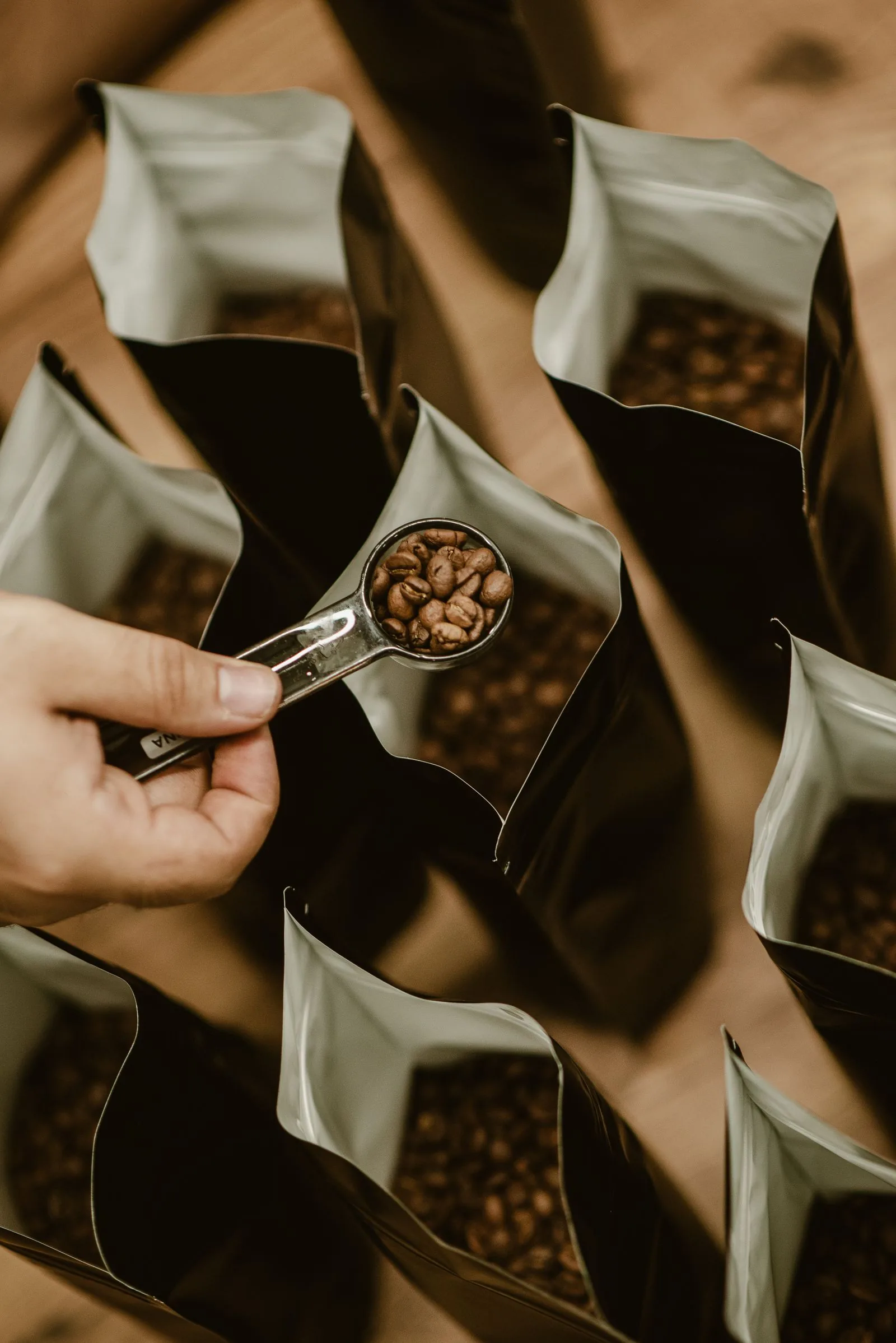
Coffee weights, explained
11 oz, 12 oz or 1 lb?
Coffee bag size has two parts: the net coffee weight and the pouch dimensions. One does not determine the other.

How big is a 12 oz bag?
12 oz is about 340 g, or 0.75 lb. Width, height and gusset vary with the coffee and bag format.
What should I measure?
Record empty W × H × G with units. Then check the filled footprint, height and clean sealing space.
What if I only have an old bag?
Send front, side and opening photos, flat measurements, old and new net weights, and your filling method.

Compare flat bottom bags and side gusset bags, or build a 12 oz sample brief.
Choose coffee bag capacity by net weight; confirm its dimensions with a fill test. An 8 oz, 12 oz or 1 lb label describes the coffee inside, not a universal pouch width or height. Roast, grind, bag shape and the filling process all affect the fit.
Coffee bag sizes at a glance
Use this chart to define the selling unit before comparing pouch samples. Ounces below mean net weight, not fluid ounces. Rounded metric conversions help with planning; use the declared net quantity required for your destination artwork.
| Selling unit | Approximate equivalent | Planning context | Check on the sample |
|---|---|---|---|
| 8 oz | 227 g | Smaller retail packs and subscriptions | Label space and zipper clearance |
| 250 g | 8.8 oz | Metric specialty retail | Do not substitute an 8 oz fill |
| 12 oz | 340 g | Specialty retail and direct sales | Roast density and filled front panel |
| 1 lb / 16 oz | 454 g | Retail, café and direct sales | Usable volume above the base folds |
| 500 g | 1.10 lb | Larger metric retail packs | Expanded gusset and case fit |
| 1 kg | 2.20 lb | Café and wholesale supply | Filling opening and handling |
| 2 lb | 907 g | Wholesale and foodservice | Seal area and carton loading |
| 5 lb | 2.27 kg | Roastery and foodservice supply | Material, seals and filled-pack handling |
A 250 g pack is heavier than an 8 oz pack; a 500 g pack is heavier than a 1 lb pack. Combining them under one artwork or ordering specification without a fill check can create an undersized pouch.
Read width, height and gusset correctly


The front panel
Record the finished width and the usable filling opening. Side seals and construction details can make the clear opening narrower than the outer dimension.
Room to fill and seal
Separate overall height from usable fill height. The zipper, tear area, headspace and final heat seal need clean space above the coffee.
The expanded depth
Identify a side gusset or bottom gusset explicitly. Confirm how it is measured; the same three numbers in a different order can describe a different bag.
Quote dimensions in millimetres or inches with the units written out. One inch equals 25.4 mm. Do not calculate usable capacity by multiplying the outer dimensions: folds, seals and the filled shape reduce the available space.
A fill test in four steps
- Use the coffee you plan to sell. Weigh the exact net quantity. Record whole bean or ground, representative roast or grind, and the packing method. Test the lowest-density coffee in a shared pack range as well as your normal blend.
- Fill candidate samples. Open the base and gussets as intended. Check whether the coffee settles evenly and whether the bag stands without excessive bulging or collapse.
- Close it as you would in production. Keep coffee away from the zipper and final seal. Check access for the filling nozzle or scoop, the valve position if used, and the clean seal area needed by your equipment.
- Review the filled pack and carton together. Check front-panel appearance, label and barcode position, opening and resealing, bags per carton, and handling. Record the accepted sample before requesting the final dieline.
Repeat the check if the roast range, grind, declared weight, material or bag construction changes. A photograph of an empty bag cannot confirm capacity, sealing behaviour or filled-pack stability.
Fill-test worksheet
A printable page for sample dimensions, coffee, clearances and approval notes.
Match the format to your sales route
Flat bottom coffee bags give a defined base and multiple artwork panels. Start here when shelf presentation and a coordinated retail range matter. Side gusset coffee bags open along the sides and are worth comparing for traditional coffee presentation, larger fills and carton planning.
A K-seal coffee bag offers another pouch construction to sample. Shape is a separate choice from barrier: the complete laminate, valve if used, seals and distribution conditions still need review. For roast-specific planning, see coffee bean packaging.
Common size questions
What are the dimensions of a 12 oz coffee bag?
There is no single dimension shared by every 12 oz bag. The net weight is approximately 340 g, while the width, height and gusset depend on the construction and your coffee. Send the intended format and a representative product sample so candidate dimensions can be checked before artwork.
Will a whole-bean bag also fit ground coffee?
It may, but the same weight can occupy a different volume. Ground coffee also changes filling behaviour and the risk of particles in the seal area. Run a separate fill and sealing check for each intended product state.
Can one size cover several roasts?
Often this is worth testing. Select representative coffees across your range, fill each to its declared weight, and compare the highest fill level, the loosest appearance and the clean seal space. Approve the shared size only after checking those extremes.
Find the right filled fit.
Send your coffee type, net weight, preferred format, filling method, quantity and destination. Custom production starts from 10,000 pieces; confirm the quantity basis for your size and artwork combination. Available standard samples are free, with shipping confirmed separately.
In practice
Compare the space you actually use.
Nominal weight is a starting point; the filled pack supplies the useful measurements.
Run a controlled comparison
Use the same coffee, net weight and loading method when comparing candidate bags. Mark each sample and record its empty dimensions, filled height, standing footprint and room left for closing. Photograph the front and side against a consistent background.
If one sample looks better, the record should show why: perhaps the face reads more clearly, the closure is easier to reach or the bag fits the case more comfortably. Do not compare an overfilled sample with a loosely filled one and attribute the difference entirely to the format.
Check the range, not one roast
If one bag will serve several coffees, include the representative coffees that create the tightest and loosest practical fit. Keep the actual dose constant for each intended SKU and record any difference in how the contents settle. Then review the label area and top closure again.
A bag approved around only one roast may create a different presentation elsewhere in the range. Agree the final dimensions with the filling team and keep the tested examples with the approved reference, rather than relying only on the capacity printed in a catalogue.