
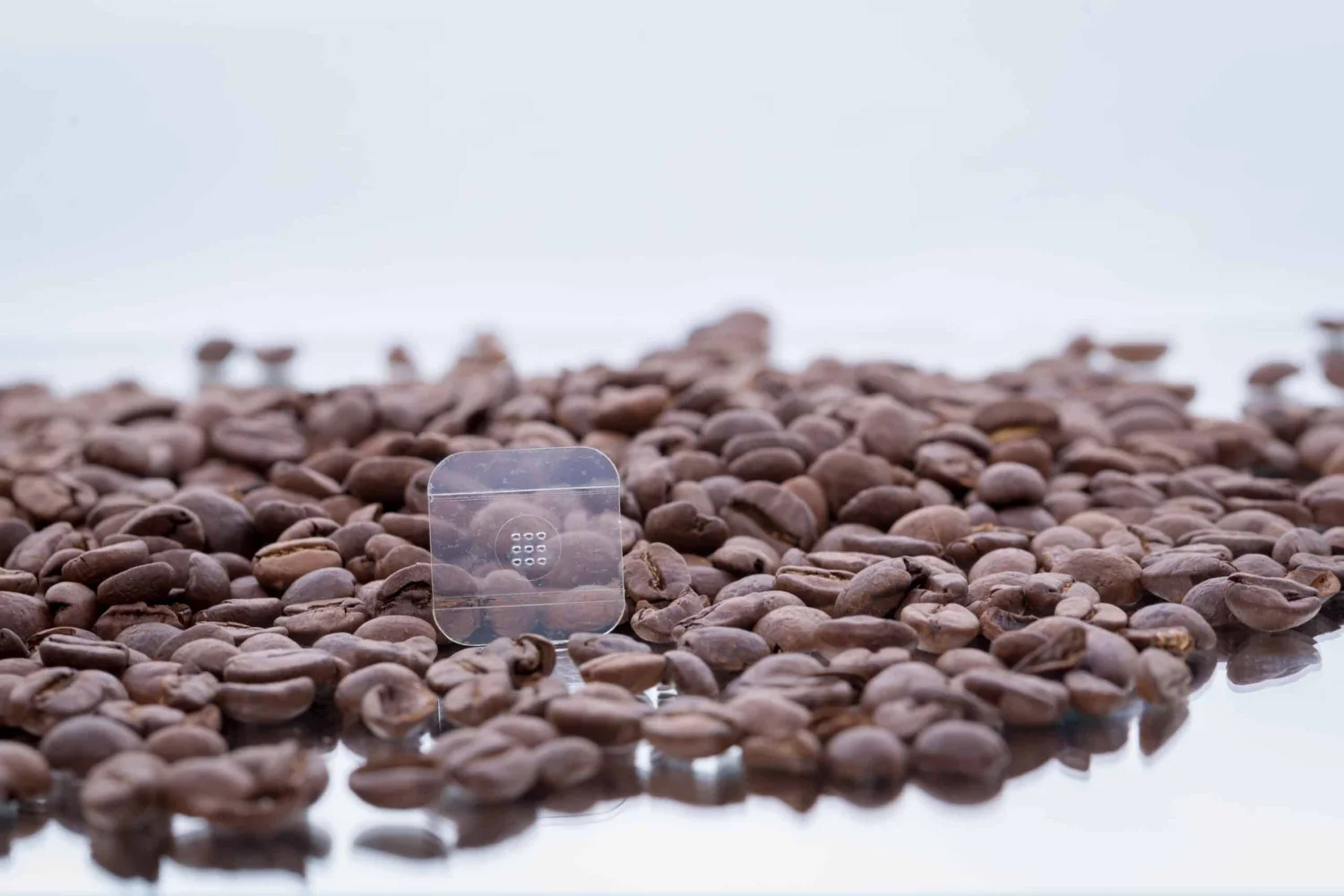
Roasting forms gases, including carbon dioxide, and some remain inside the porous structure of roasted coffee before being released during storage. Grinding changes the release behavior. This is why valve decisions begin with the coffee and packing process rather than with a bag-style checklist.
When we review a one-way valve
| Project condition | Valve review |
|---|---|
| Whole beans packed soon after roasting | Usually review a one-way valve together with headspace, seal and target distribution. |
| Ground coffee | Review packing timing, gas flushing, residual oxygen, pack geometry and the customer’s freshness plan before deciding. |
| Coffee intentionally rested before packing | Confirm actual degassing practice and shelf-life plan; do not assume the same valve configuration as fresh-pack coffee. |
| Vacuum or rigid format | Valve choice depends on the complete package and processing route, not on flexible-pouch convention. |
The inputs we record
- Whole bean or ground coffee, roast direction and coffee density
- Typical hours or days between roast and sealing
- Net weight, pouch size and expected headspace
- Manual or automated filling, packing speed and gas-flush route
- Target freshness window, shipping route and storage conditions
The valve is engineered into the pouch
The specification identifies valve model, installation method, nominal position, orientation, surrounding laminate and clearance from zipper, folds and seals. Position also matters visually: a valve can distort a label, interrupt artwork or sit on a panel that bends during filling.
Opening behavior should be reviewed using the supplier’s controlled valve data and a filled-pack trial. There is no responsible universal claim that one valve pressure or one packing delay works for every roast and bag.
Verification on production-representative bags
- Confirm the valve and laminate match the written bill of materials.
- Check valve position and installation on finished pouches.
- Fill representative bags using the intended coffee and net weight.
- Inspect the top seal, zipper, headspace and any panel distortion.
- Monitor leakage, gas release and pack appearance through the agreed trial period.
A valve is one controlled component in a larger freshness system. Barrier film, seals, residual oxygen, storage temperature and the consumer’s use after opening still affect the coffee.
Research notes
Sources & standards
- Smrke et al.: time-resolved measurement of gas release from roasted coffee
- Specialty Coffee Association: literature review on roasted coffee staling
- Baggenstoss et al.: water-quench cooling, degassing and aroma stability
Technical references explain the decision framework. Final performance and compliance depend on the exact approved construction, test conditions, intended use and destination market.