Fill
Load and close the liner using its planned filling route.
 Get a Quote
Ready-to-Drink & Liquid Coffee Packaging
A barrier liner and outer carton system for larger coffee concentrate and foodservice volumes.
Sizes & capacity: 3 L, 5 L, 10 L, 20 L, and custom capacities
Use case
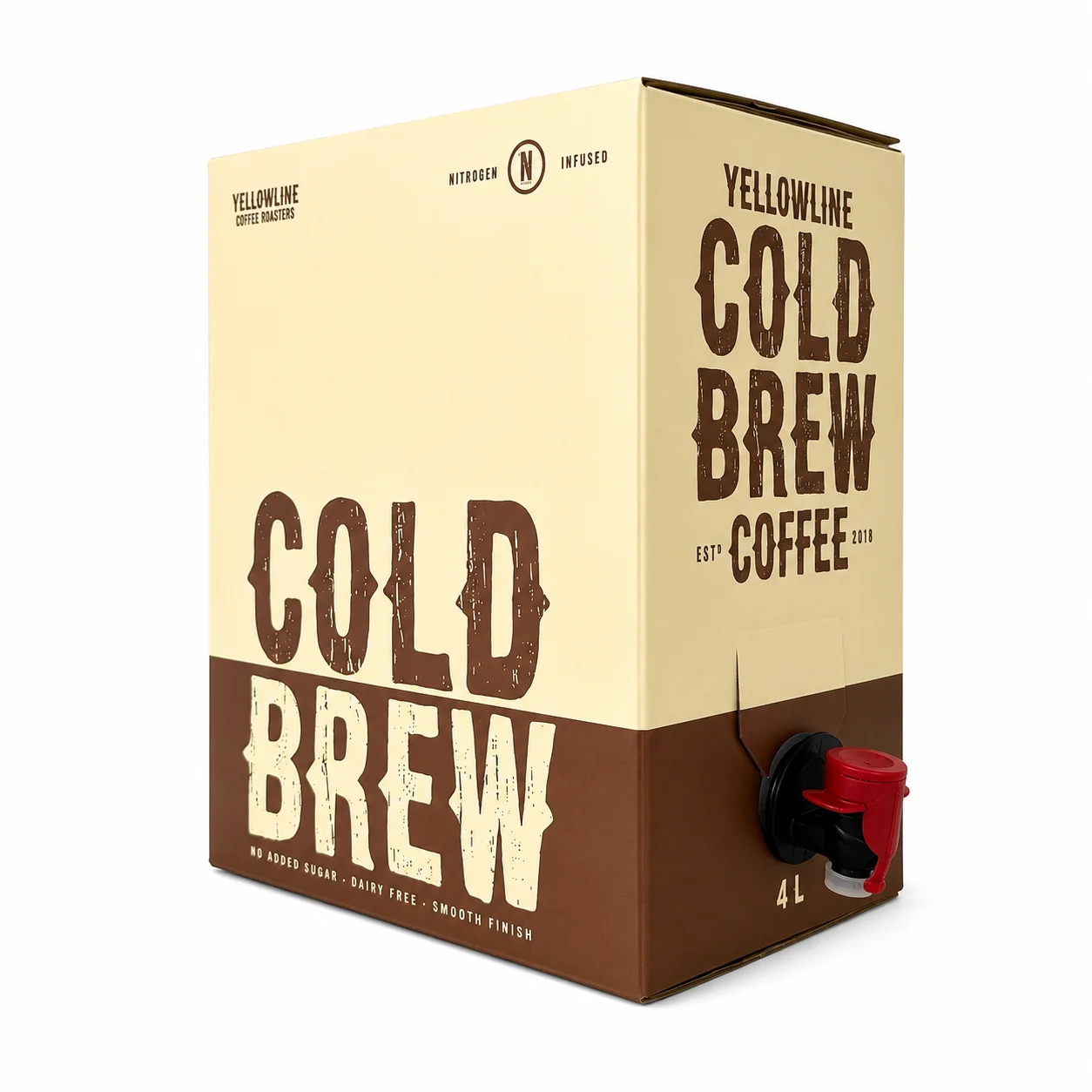
Bag-in-Box Packaging combines a flexible barrier liner, connector or tap, fill method, and corrugated outer carton for larger liquid-coffee volumes. Review repeated dispensing, oxygen exposure, carton support, and transport handling as one system.
Format details
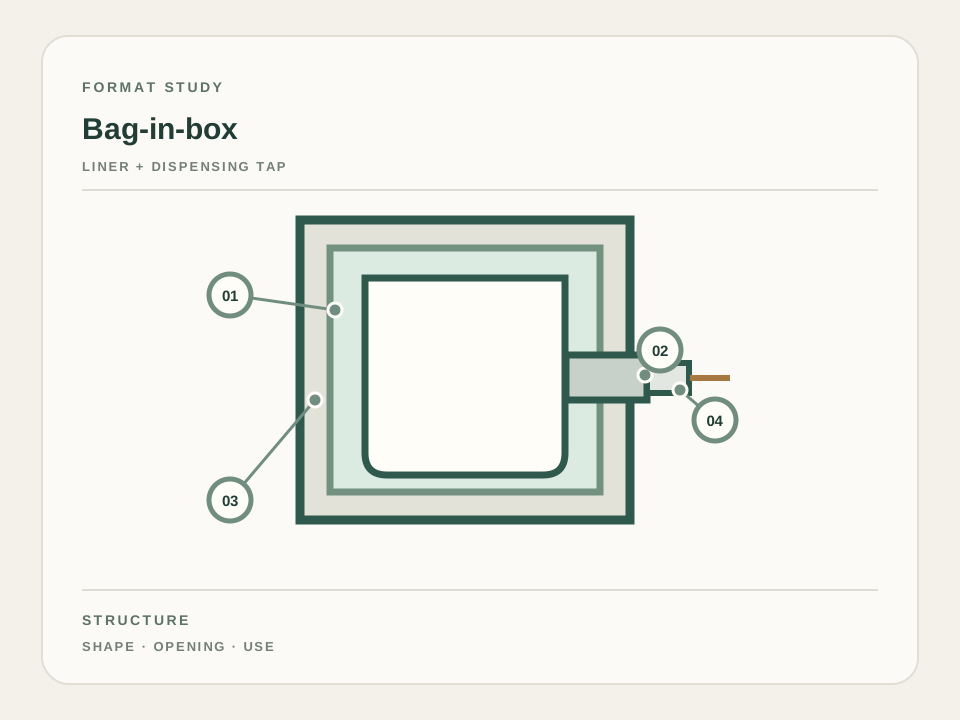
Bag-in-box packaging pairs a sealed flexible liner with a protective corrugated carton. The liner holds the liquid, while a fitment or tap passes through a carton opening for dispensing. The carton helps the filled system keep its shape during storage and handling, but the two parts have separate specifications. The liner fold, fitment orientation, fill method, carton opening, and dispensing equipment all need to agree.
Practical sequence
Load and close the liner using its planned filling route.
Place the liner in the carton and align the connector.
Open the carton access and operate the tap or connector.
Choose liner capacity and structure, fitment or tap, carton size, access opening, orientation, and print.
Assemble a filled system and check fitment access, liner folds, carton support, dispensing, and case handling. Test the tap through the full intended use, including the carton opening and the space needed to position a serving container. Confirm the assembled system fits its shipping case.
A café group needs a larger liquid-coffee format for repeated dispensing. Specify the filled volume, liner fold, tap or connector, carton access opening, station clearance, and shipping orientation as one assembly. Fill and install a representative system, then check that staff can reach and operate the tap without pulling the liner against a sharp edge. Observe drips, leaks, carton support, and the amount left after opening. Confirm whether the pack fits the customer’s cooler or counter. Review the liner and carton as separate controlled components with linked revisions. Confirm carton and fitment clearances at the actual serving station, then check how the liner empties without collapsing or blocking the outlet during use. Check tap position and carton access before printing the opening.
Plan around this format
Bag-in-box selection is driven by the dispensing routine and the space around it. Confirm liquid volume, fill method, liner structure, connector or tap, carton dimensions, orientation, and the equipment used by the customer. Fill and assemble a representative system, then check fitment access, repeated dispensing, leaks, panel folds, carton support, pallet or case handling, and the remaining product after opening.
The liner and carton should have linked specifications and version numbers. Artwork needs to identify the outer case without obscuring handling marks or the connector instructions.
Buying notes
Open the question that matches your next decision.
The listed size or capacity options are 3 L, 5 L, 10 L, 20 L, and custom capacities. Confirm the project dimension or capacity, product dose where relevant, fit or interface, seal area, and filled or assembled dimensions before approving the artwork.
The inner barrier bag, connector or tap, fill method, outer carton, and dispensing route need to be reviewed together. Confirm repeated opening, oxygen exposure, fitment, carton support, and transport handling.
Send the product, target size or dose, current format, artwork status, quantity, destination, and preferred sample or quote route. Start with Multi-layer barrier film with corrugated carton and use the checks below to frame the first discussion.
Choose with confidence
A bag-in-box system connects the liner, dispensing fitment and outer box. Start with your filling and serving routine so the components work together for the intended user.
See how samples are reviewedShare the liquid, volume, filling method, storage conditions and dispensing setup. Confirm which liner, connector, tap and outer-box components are included, then check fit with the intended equipment and handling routine.
Confirm the outer box’s printed faces, opening points and dispensing instructions. Keep the liner and fitment reference attached to that design so the branded box and working system describe the same project.
Try filling, assembly, connection, dispensing and case handling with the intended product and equipment. Record the component list and trial conditions. Confirm each supplied part and the agreed shipping arrangement in the written quotation.
In practice
Treat the inner bag, tap and outer box as one working package.
Imagine the box being unpacked, positioned and used behind a café counter. Check how the tap is located, how staff reach it and how the container sits beneath it.
Use the intended filled volume and normal operating position. A convenient box footprint is not enough if the dispensing setup is awkward or the tap access is hidden by the printed design.
Ask whether the quotation includes the inner bag, fitment, tap, printed box and any assembly or packing requirements. Identify which party fills and closes the system.
Keep component references and quantities on the same brief. Two offers for bag-in-box packaging can cover different parts of the system, so compare the complete delivered scope rather than only the price beside the format name.
Check which product, lot and use instructions remain visible once the tap opening is used and the box is placed in service. Storage and use-after-opening directions must come from the coffee producer’s validated product requirements.
Review case orientation and handling with the filling partner, and keep the agreed inspection points with the order. Do not infer ambient storage suitability from the outer box or dispensing format.
Product enquiry
Share your coffee, fill weight, planned quantity and destination. Ask about fit, samples or pricing; we will review the details needed for a useful quotation.
Custom production usually starts from 10,000 pieces. Available standard samples are free; shipping is confirmed separately.